

If you’re looking for improved sound quality and a better playing experience, understanding what guitar action is and how to adjust it are essential skills for every guitarist.
This guide provides a thorough overview of what guitar action is, why it’s important, ideal action settings for different types of guitars, how to measure, and how to adjust the action on your guitar.
Get ready to take your playing up a notch!
What is action on a guitar?
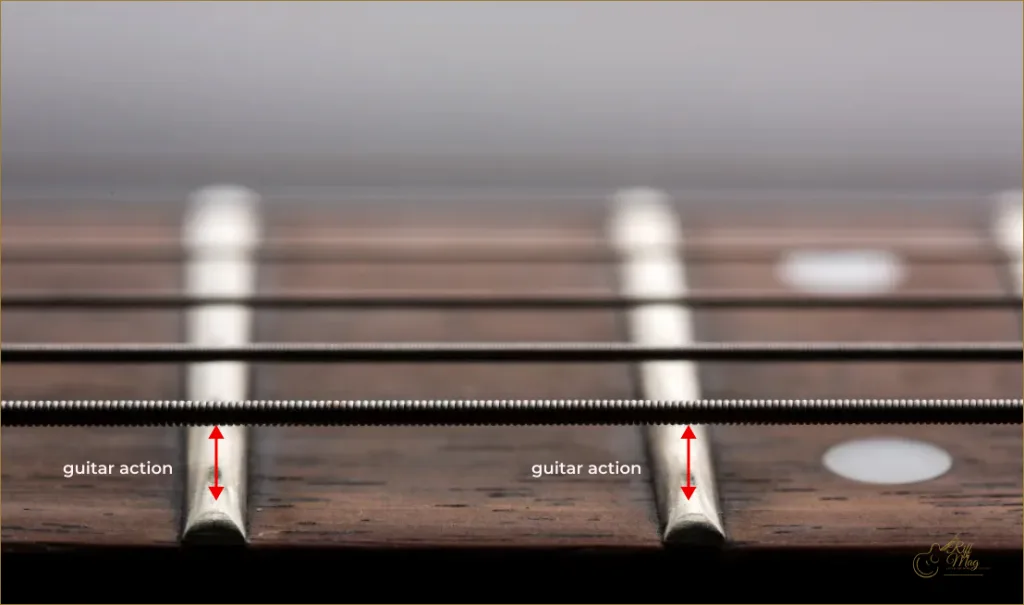
Action is the distance between the strings and the fretboard of a guitar, and it is an important element in producing quality sound.
When an electric guitar has a higher action, there is more space between the strings and fretboard giving you more control over each note you play. However, this can also cause buzzing when playing certain notes.
On the other hand, if an electric guitar has a low action it can give off a nice crisp sound but it will be harder to play because there isn’t as much room to maneuver when pressing down on each string.
It takes practice to get used to both types of actions but understanding how they work together can help create beautiful music.
Is guitar action important?
Guitar action can make a vast difference in how well your guitar plays and sounds; it affects both tone and playability.
Here are some reasons why guitar action is important:
- The action affects the comfort on the fretboard, allowing for better note accuracy and less effort when playing chords.
- Properly setup action allows for better intonation, ensuring notes stay in tune during longer performances.
- Lowered action helps increase sustain, creating a bigger sound with greater resonance.
What is the ideal action for your guitar?
The ideal action depends on the type of your guitar.
Now we will examine the actions of different types of guitars so you can easily understand what is the perfect one for your instrument.
Ideal Action For an Electric Guitar
Choosing the ideal action for your electric guitar is an important step in optimizing your playing experience. To help you make the best decision, here are three things to consider:
What type of strings are you using?
Thinner strings tend to move more when they’re plucked and can cause more buzzing than thicker strings, so a higher gauge may be better for achieving a lower action without the notes going dead.
Compare manufacturer recommendations with shredders’ preferences
Fender recommends 1.6mm on both sides, while Ibanez suggests 1.5mm on the treble side and most shredders go as low as 1mm for the treble strings.
In the end, it really comes down to what you prefer
What works for one player may not work for another, so experiment with different actions before settling on one that feels right for you.
At the end of the day, finding an action that suits your style and provides comfortable playability should be your top priority.
Ideal Action For an Acoustic Guitar
Acoustic guitars generally require higher action than electric guitars because it benefits the sound of the instrument.
Martin Guitars set the action of their guitars with relatively high action and thicker strings (.12 gauge), while Taylors tend to come with thinner strings (.11/.10) and lower action.
Balancing playability and sound is key when adjusting the action on an acoustic guitar.
Too low of an action could lead to fret buzz, whereas too high could make it difficult to play. It’s possible to reduce the action without sacrificing tone; however, you may need to adjust other elements such as truss rod tension or bridge height to make this happen.
With careful adjustments, it’s possible for an acoustic guitar to achieve ideal playing conditions while still sounding great!
Ideal Action for A Classical Guitar
Low action is usually associated with classical guitars to ensure better playability, although this might result in a slight loss of tone.
To make up for this, strings used on classical guitars are typically lighter than those found on acoustic guitars – delivering an easier fretting experience without sacrificing volume or tone.
Although low action of your guitar may seem like the ideal solution, high action has its own advantages for classical guitars as well.
With high action, there’s no need to worry about tone loss since the sound of a classical guitar is already softer and mellower compared to an acoustic guitar. Furthermore, it often eliminates buzzing and string noise that could occur when playing with very low action.
High or Low Action: Which is Best?
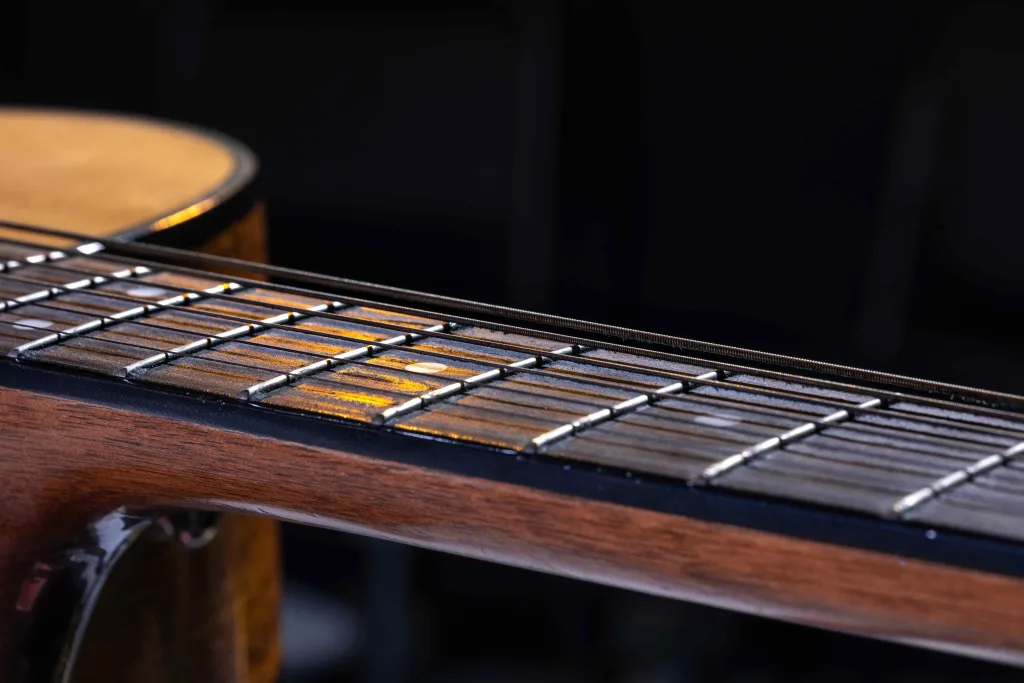
Both types of actions can provide different benefits for guitar players, depending on their playing style and preference. It’s important to understand how both high and low action can affect your playing in order to make an informed decision about which type will be best for you.
High guitar action
Having high action on a guitar comes with both benefits and weaknesses.
Pros of High Action
- Enhanced Control: With more distance between the strings and fretboard, high action allows you to dig into the strings, providing greater control when bending notes and playing. This enables you to elevate your skills and explore new techniques.
- Improved Slide Guitar Performance: High action is beneficial for slide guitarists, as it prevents the slide from colliding with the frets while playing. This eliminates unwanted buzzing or interference, allowing for smoother and more precise slide movements.
- Reduction of Fret Slap: High action can minimize fret slap, which refers to the clanking noise that occurs when releasing your fingers from the frets after pressing too hard. By reducing this unwanted sound, high action promotes cleaner and clearer notes.
- Finger Strength and Skill Development: Playing with high action requires greater finger strength and dexterity. Regular practice on a guitar with high action can help strengthen your fingers, improving overall playing ability and technique.
- Elevates Guitar Playing: Overall, high action offers numerous benefits that can elevate your guitar playing to a whole new level. From enhanced control and improved slide performance to reduced fret noise and finger strength development, high action can be a valuable asset for advancing your skills and musical expression.
Cons of High Action
- Increased Difficulty in Playing: High action requires exerting more pressure on the strings, making it physically more demanding and potentially fatiguing for your fingers. The greater distance between the strings and fretboard can make it harder to press down on the strings and execute precise fretting.
- Noise Interference: When changing finger positions on a guitar with high action, there can be increased noise interference. This becomes particularly noticeable when using effects or recording in a studio environment. The additional space between the strings and fretboard can lead to unintentional string rattling or buzzing, negatively impacting the overall sound quality.
- Limited Fret Release: With high action, the transition from fretted positions to open positions can feel less smooth and comfortable. The increased distance between the strings and fretboard results in less immediate release when lifting your fingers off the frets, potentially affecting your ability to execute quick position changes or legato playing.
Low guitar action
Low action on a guitar is generally considered an advantage because it allows for easier playing, greater accuracy, and faster execution of notes. However, there are some drawbacks.
To decide whether or not low action is right for you, it’s important to weigh both pros and cons carefully.
Pros of Low Action
- Easier and More Precise Playing: Low action makes playing the guitar easier and more enjoyable. It allows for sharper and more accurate sound production, giving you better control over your playing.
- Great for Studio Recording: Low action guitars produce a clear and well-defined sound, which is ideal for studio recordings. It helps in achieving accurate and precise sound mixing during recording sessions.
- Less Noisy Fret Slap: Low action significantly reduces the clanking noise that occurs when you release your fingers from the frets. This leads to cleaner and more professional recordings and performances.
- Smooth and Strong Feel: Guitars with low action feel smoother and more solid when you play them. The strings are closer to the fretboard, making it easier to perform techniques like bending, vibrato, and sliding.
- Clear and Vibrant Tone: Low action allows the guitar strings to vibrate freely, resulting in a clear and vibrant tone. It enhances the resonance and sustain of the strings, producing a rich and expressive sound.
Pros of Low Action
- Fret Buzz: One of the main disadvantages of low action is the potential for fret buzz. Fret buzz occurs when the strings come into contact with the frets due to their close proximity to the fretboard. This can result in an unpleasant buzzing sound that hampers clean and clear playing.
- Intonation Challenges: Adjusting the string tension on a low action guitar can affect the intonation, which refers to the accuracy of the guitar’s pitch. Achieving proper intonation may require adjustments that can be challenging, especially for those who are not experienced with this process.
- String Rattling: With low action, there is a higher likelihood of strings rattling against the frets or other parts of the guitar. This can produce unwanted noise and interfere with the overall sound quality, particularly when playing aggressively or using certain techniques.
- Increased Risk of String Slippage: Low action guitars may have a higher risk of strings slipping out of tune or unintentionally being muted. The lower string height can make it more difficult to maintain proper string tension and stability, requiring more frequent tuning and adjustments.
- Potential for Limited Tone and Projection: Extremely low action can sometimes result in a loss of tone and projection. The reduced string action height may limit the natural vibration of the strings, affecting the overall richness and volume of the sound produced.
How to measure guitar action
You can measure guitar action with a specialized guitar ruler, feeler gauge, or even some DIY items you have lying around the house.
With these tools in hand, you’ll be able to accurately measure the height of each string from the fretboard and make necessary adjustments to get the perfect action for your playing style.
Measure guitar action with a ruler
With a specialized ruler, you can easily measure the distance between your frets and strings for precise action. To use it, you just need to place the long side of the ruler upright on the frets, perpendicular to the fretboard and parallel to the strings.
Then you’ll be able to measure from the top of the fret to the bottom of the string. This will give you an accurate measurement of your guitar’s action. The black squares on these rulers are also very helpful in measuring action as they come in different sizes so you can get exact readings.
Just remember that metric measurements are usually better for guitars since it’s easier to make small and precise calculations with them.
Measure guitar action with a feeler gauge
The feeler gauge offers an easier measuring method for those who struggle with small numbers. Using a feeler gauge involves placing different thin steel plates of varying thicknesses between the fret and string, one at a time, without pushing the string up.
This process helps to read whether both the string and fret touch it.
We recommend using both a ruler and a set of feeler gauges to get an accurate measurement of guitar action.
Here’s how to do it:
- Position the feelers between the strings and frets.
- Check if both string and fret touch it.
- Take other measurements like nut slot width or neck relief.
Using this combination ensures that you get the most optimal action for your guitar as possible. Feeler gauges are easy to use while providing an efficient way to measure up accurately even on guitars with complex shapes or hard-to-read parts such as nuts and saddles.
Measure guitar action with DIY items
You can measure the guitar action with DIY items if you’re unable to or don’t want to spend money on feeler gauges.
You can use picks of different sizes, string clippings, and pieces of paper as makeshift gauges.
To get the right size measurements, stack the picks and strings together or use paper with known thicknesses from their packaging.
As long as you know what thickness each item is, you can accurately measure your guitar action.
Adjusting Your Guitar’s Action
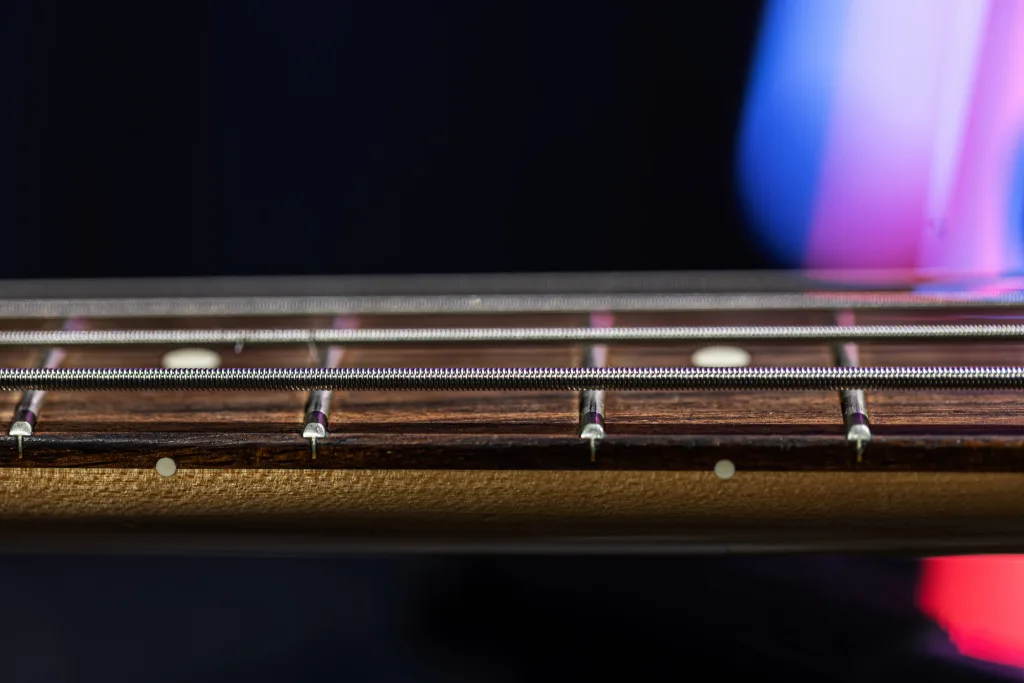
Adjusting the action on your electric, acoustic, or classical guitar can be a daunting task, but with a little bit of knowledge and patience, you can easily adjust the action on any guitar.
How to adjust the action on an electric guitar
Adjusting your action is one way to customize your playing experience and ensure that your guitar plays as comfortably and accurately as possible.
Here’s a list explaining different types of guitar bridges and their effects on electric guitars action:
- Tune-o-Matic bridges: These bridges have adjustable saddles, which means you can change the height of each string individually. This allows for precise intonation adjustment (getting the guitar in tune across all frets) and setting the string action (how high the strings are from the fretboard). Tune-o-Matic bridges come in two versions: 6-saddle and 2-saddle.
- Hardtail bridges: These bridges allow for higher string action without compromising tuning stability or accuracy. They are suitable for heavier music styles where players prefer more sustain from their guitars. With hardtail bridges, you can set the strings higher off the fretboard while still maintaining good tuning.
- Fender style vibrato bridges: These bridges have tension springs that help maintain the strings at a desired tension level, even when using the tremolo bar (whammy bar). Fender style vibrato bridges provide a wide range of sounds, from subtle vibratos to wild whammy effects. The tension springs contribute to the stability of the bridge and keep the strings in tune.
- Floyd Rose style bridges: Compared to traditional locking tremolos found on Fender Strats or Telecasters, Floyd Rose style bridges offer increased tuning stability and improved sustain. They feature a double locking design, which means you can make radical changes to your guitar’s tone without going through the entire setup process every time. Floyd Rose bridges are known for their ability to hold tuning even with extreme tremolo use.
- Other tremolo systems like Hipshot’s “Tremsetter”: Apart from the aforementioned bridges, there are various other tremolo systems available. Hipshot’s “Tremsetter” system is one example. It works by suspending the strings over a spring-loaded arm rather than attaching them directly to the guitar’s body like most traditional systems. This design helps prevent unwanted noise or buzzing caused by improperly adjusted tremolos while still allowing for full use of its functions, such as raising or lowering the pitch.
Read more on how to adjust the action on electric guitar.
How to adjust the action on an acoustic guitar
Adjusting the action of your acoustic guitar is a bit different than adjusting an electric one, so make sure you take your time and get it right.
- To start, take off all the strings from your acoustic guitar.
- Find the bridge saddle, which is a small piece made of plastic or bone. It determines the height of each string as it passes over it.
- If you want to decrease the string height (lower the action), take a screwdriver and carefully turn each bridge saddle screw in a counter-clockwise direction. Make sure to adjust all the screws equally.
- To increase the string height (raise the action), use the screwdriver to turn each bridge saddle screw in a clockwise direction until it reaches the desired height. Again, adjust all the screws evenly.
- Once you have adjusted the bridge saddle screws, it’s time to put new strings on your guitar.
- After installing the new strings, tune them up to the desired pitch.
Your acoustic guitar is now ready to be played again with the adjusted action.
How to adjust the action on a classical guitar
To adjust the action on a classical guitar, several distinct elements need to be considered. Here are four steps to take in order to make the necessary adjustments:
- Check the neck relief: Use a ruler or straight edge and place it across the fingerboard near its center. Gently press down on the string one octave above middle C with your other hand and observe the gap underneath the straight edge.
- Adjust the truss rod: Unscrew the truss rod nut until you can turn the rod freely with a small wrench or Allen key (depending on the model). Turn clockwise to decrease relief, counterclockwise to increase relief, and recheck neck relief after each adjustment.
- Set the bridge saddle height: Loosen the strings and turn the screws at the base of the saddle until the desired height is achieved. Use a feeler gauge for accuracy if necessary. Retune the strings afterward and check intonation from the 12th fret harmonic clear up the entire fretboard range, rather than just open strings.
- Check the nut slot depth: Check the low E string 1st fret clearance with a feeler gauge. If it’s too high, file the slots deeper using nut files or sandpaper wrapped around a thin wooden dowel for better control and even filing motion. Use a light lubricant like graphite powder for smoother operation afterward!
Conclusion
In a nutshell, guitar action is all about finding that perfect balance between comfort and sound. It refers to the height of the strings from the fretboard, and getting it right can make a world of difference in your playing experience. By measuring and adjusting the action with care, you’ll be able to customize your guitar to suit your style and preferences. So, don’t be afraid to experiment and find that sweet spot that feels just right for you. Happy strumming!
FAQ
How do I know if my guitar action is too high or too low?
To determine if you have too high or too low action, check the distance between your strings and fretboard.
If the gap is wider than 3 mm, then your action is considered high; if it’s less than 2 mm, then it’s likely low.
In addition, you can also test the playability of your guitar by playing a few notes and chords on different frets – if they sound muffled or require more effort than usual to press down, then it could be an indication that your action is off.
Does the type of wood used for the guitar neck affect the action?
Yes, the type of wood used for the guitar neck can have a significant impact on the action.
Wood has a unique ability to absorb and release energy over time, which affects how it vibrates when strings are strummed.
Harder woods like maple and ebony tend to create less resonance than softer woods like cedar and mahogany, resulting in higher action.
On the other hand, softer woods will allow greater string vibration which usually results in lower action.
Related posts:

Thanks a lot for giving everyone an extraordinarily breathtaking opportunity to read critical reviews from this blog. It’s always very awesome and as well , packed with a good time for me personally and my office peers to visit your web site a minimum of 3 times in one week to read the fresh guides you have got. Not to mention, we are usually motivated for the incredible principles you serve. Certain 4 areas in this post are truly the most impressive I have ever had.
Very fantastic information can be found on blog.
Hey there! I’ve been reading your web site for some time now and finally got the courage to go ahead and give you a shout out from Porter Texas! Just wanted to say keep up the great work!
I like what you guys are up too. Such intelligent work and reporting! Keep up the superb works guys I have incorporated you guys to my blogroll. I think it’ll improve the value of my site 🙂
Thanks , I’ve just been looking for info about this topic for ages and yours is the best I have discovered so far. But, what about the conclusion? Are you sure about the source?
Hello. splendid job. I did not expect this. This is a remarkable story. Thanks!
Nice post. I was checking constantly this blog and I’m impressed! Extremely useful information particularly the last part 🙂 I care for such info a lot. I was looking for this certain info for a very long time. Thank you and best of luck.
Hello, Neat post. There’s a problem together with your website in internet explorer, would check this?K IE still is the market chief and a big element of other people will miss your magnificent writing because of this problem.
Great wordpress blog here.. It’s hard to find quality writing like yours these days. I really appreciate people like you! take care
Oh my goodness! an incredible article dude. Thank you Nevertheless I’m experiencing issue with ur rss . Don’t know why Unable to subscribe to it. Is there anybody getting identical rss downside? Anybody who knows kindly respond. Thnkx
Your place is valueble for me. Thanks!…
Merely wanna comment on few general things, The website layout is perfect, the written content is very good : D.
Pretty! This was a really wonderful post. Thank you for your provided information.
Merely wanna remark on few general things, The website style is perfect, the written content is real good : D.
I like this weblog so much, saved to favorites. “Nostalgia isn’t what it used to be.” by Peter De Vries.
Nice post. I learn something more challenging on different blogs everyday. It will always be stimulating to read content from other writers and practice a little something from their store. I’d prefer to use some with the content on my blog whether you don’t mind. Natually I’ll give you a link on your web blog. Thanks for sharing.
I am always thought about this, appreciate it for posting.
Hi, i read your blog occasionally and i own a similar one and i was just wondering if you get a lot of spam comments? If so how do you stop it, any plugin or anything you can recommend? I get so much lately it’s driving me crazy so any help is very much appreciated.
I was looking through some of your content on this site and I think this site is real instructive! Retain putting up.
Having read this I thought it was very informative. I appreciate you taking the time and effort to put this article together. I once again find myself spending way to much time both reading and commenting. But so what, it was still worth it!
I am forever thought about this, thanks for posting.
Hi there! I could have sworn I’ve been to this site before but after checking through some of the post I realized it’s new to me. Nonetheless, I’m definitely happy I found it and I’ll be book-marking and checking back often!
Terrific post however I was wanting to know if you could write a litte more on this subject? I’d be very thankful if you could elaborate a little bit further. Bless you!
My coder is trying to convince me to move to .net from PHP. I have always disliked the idea because of the costs. But he’s tryiong none the less. I’ve been using WordPress on several websites for about a year and am anxious about switching to another platform. I have heard excellent things about blogengine.net. Is there a way I can transfer all my wordpress content into it? Any help would be really appreciated!
I love your blog.. very nice colors & theme. Did you design this website yourself or did you hire someone to do it for you? Plz respond as I’m looking to construct my own blog and would like to find out where u got this from. thanks
I am really impressed with your writing skills and also with the layout on your blog. Is this a paid theme or did you customize it yourself? Anyway keep up the nice quality writing, it’s rare to see a great blog like this one these days..
Outstanding post, I think blog owners should learn a lot from this web site its very user pleasant.
You are my intake, I have few blogs and occasionally run out from to brand : (.
Saved as a favorite, I really like your blog!
Heya just wanted to give you a quick heads up and let you know a few of the pictures aren’t loading properly. I’m not sure why but I think its a linking issue. I’ve tried it in two different internet browsers and both show the same results.
Hello there, I found your blog by the use of Google even as looking for a comparable matter, your website came up, it seems to be good. I’ve bookmarked it in my google bookmarks.
I know this if off topic but I’m looking into starting my own blog and was wondering what all is needed to get set up? I’m assuming having a blog like yours would cost a pretty penny? I’m not very internet savvy so I’m not 100 certain. Any tips or advice would be greatly appreciated. Thank you
Youre so cool! I dont suppose Ive read anything like this before. So nice to find somebody with some original thoughts on this subject. realy thank you for starting this up. this website is one thing that’s wanted on the net, someone with somewhat originality. helpful job for bringing one thing new to the web!
I am not sure where you are getting your info, but great topic. I needs to spend some time learning much more or understanding more. Thanks for excellent information I was looking for this information for my mission.
I got what you intend,saved to fav, very decent website .
The next time I read a blog, I hope that it doesnt disappoint me as much as this one. I mean, I know it was my choice to read, but I actually thought youd have something interesting to say. All I hear is a bunch of whining about something that you could fix if you werent too busy looking for attention.
Hello just wanted to give you a quick heads up. The words in your post seem to be running off the screen in Safari. I’m not sure if this is a formatting issue or something to do with browser compatibility but I thought I’d post to let you know. The design and style look great though! Hope you get the issue solved soon. Many thanks
Hi, i think that i saw you visited my website so i came to “return the favor”.I am attempting to find things to enhance my site!I suppose its ok to use a few of your ideas!!
TURMERIC TRICK
very nice put up, i certainly love this website, carry on it
Wow! This can be one particular of the most useful blogs We’ve ever arrive across on this subject. Actually Excellent. I’m also a specialist in this topic therefore I can understand your effort.
I’m extremely impressed with your writing talents and also with the structure to your weblog. Is that this a paid topic or did you customize it yourself? Either way keep up the excellent quality writing, it’s uncommon to peer a great blog like this one these days..
Nice read, I just passed this onto a colleague who was doing some research on that. And he just bought me lunch because I found it for him smile Thus let me rephrase that: Thanks for lunch! “High living and high thinking are poles apart.” by B. J. Gupta.
That is really interesting, You’re an excessively professional blogger. I have joined your rss feed and sit up for seeking extra of your wonderful post. Also, I’ve shared your site in my social networks!
Thanks for the sensible critique. Me & my neighbor were just preparing to do a little research about this. We got a grab a book from our area library but I think I learned more clear from this post. I am very glad to see such great info being shared freely out there.
Youre so cool! I dont suppose Ive read anything like this before. So good to seek out any individual with some unique thoughts on this subject. realy thanks for starting this up. this web site is something that’s needed on the web, someone with just a little originality. useful job for bringing something new to the web!
Hydrogen Peroxide for ed
Horse Gelatin Trick Recipe for Men
Incredible! This blog looks just like my old one! It’s on a entirely different topic but it has pretty much the same page layout and design. Excellent choice of colors!
Great site! I am loving it!! Will be back later to read some more. I am bookmarking your feeds also.
Thank you for sharing superb informations. Your site is very cool. I’m impressed by the details that you have on this web site. It reveals how nicely you perceive this subject. Bookmarked this website page, will come back for more articles. You, my friend, ROCK! I found simply the information I already searched everywhere and simply could not come across. What a great site.
GELATIN TRICK RECIPE
HORSE GELATIN
I genuinely enjoy studying on this internet site, it holds fantastic blog posts. “Do what you fear, and the death of fear is certain.” by Anthony Robbins.
Attractive component to content. I simply stumbled upon your web site and in accession capital to say that I acquire in fact enjoyed account your blog posts. Anyway I will be subscribing on your feeds and even I fulfillment you get entry to constantly rapidly.
jellyfil supplement
does slimtide work
I’ve learn some just right stuff here. Definitely price bookmarking for revisiting. I surprise how much attempt you put to make any such wonderful informative web site.
gelatin trick recipe
You have brought up a very fantastic points, thankyou for the post.
What i do not realize is actually how you’re not really much more well-liked than you may be right now. You’re so intelligent. You realize thus considerably relating to this subject, made me personally consider it from a lot of varied angles. Its like women and men aren’t fascinated unless it is one thing to do with Lady gaga! Your own stuffs nice. Always maintain it up!
Very interesting topic, regards for putting up.
Utterly pent content, Really enjoyed looking through.
I have not checked in here for some time since I thought it was getting boring, but the last few posts are good quality so I guess I’ll add you back to my daily bloglist. You deserve it my friend 🙂
HORSE GELATIN FOR MEN RECIPE
whoah this blog is great i love reading your articles. Keep up the good work! You know, lots of people are hunting around for this info, you could aid them greatly.
jellyfil supplement reviews
I do love the way you have presented this specific concern and it does present us some fodder for thought. However, coming from everything that I have experienced, I really hope as the remarks pack on that folks continue to be on point and in no way get started upon a tirade associated with the news of the day. Anyway, thank you for this superb point and whilst I can not really concur with this in totality, I respect your point of view.
I am really loving the theme/design of your blog. Do you ever run into any internet browser compatibility issues? A few of my blog audience have complained about my website not operating correctly in Explorer but looks great in Firefox. Do you have any suggestions to help fix this problem?
Some genuinely great blog posts on this website, thank you for contribution. “Careful. We don’t want to learn from this.” by Bill Watterson.
Thank you so much for giving everyone an exceptionally splendid possiblity to read in detail from this website. It is often very terrific and also packed with a lot of fun for me personally and my office fellow workers to visit your site at least thrice every week to study the latest stuff you will have. Of course, I am also at all times fulfilled considering the special solutions you serve. Certain 3 facts in this article are essentially the most efficient we have had.
Thanks for the auspicious writeup. It if truth be told was a enjoyment account it. Glance advanced to far brought agreeable from you! However, how can we be in contact?
Keep up the fantastic work, I read few posts on this internet site and I think that your blog is real interesting and holds sets of excellent information.
I’ve recently started a site, the info you offer on this web site has helped me greatly. Thanks for all of your time & work.
When I originally commented I clicked the “Notify me when new comments are added” checkbox and now each time a comment is added I get several emails with the same comment. Is there any way you can remove people from that service? Thanks a lot!
You actually make it seem so easy with your presentation but I find this matter to be really something which I think I would never understand. It seems too complex and very broad for me. I am looking forward for your next post, I’ll try to get the hang of it!
horse gelatin trick ingredients
After all, what a great site and informative posts, I will upload inbound link – bookmark this web site? Regards, Reader.
Lovely website! I am loving it!! Will come back again. I am bookmarking your feeds also.
My wife and i have been now peaceful that John managed to round up his basic research from the precious recommendations he received from your blog. It’s not at all simplistic to just happen to be making a gift of hints which usually some people may have been trying to sell. And we understand we have got the blog owner to give thanks to for this. The type of illustrations you made, the easy web site navigation, the friendships you help engender – it’s everything unbelievable, and it’s making our son in addition to our family do think this content is amusing, which is certainly extremely essential. Thanks for the whole lot!
I like what you guys are up too. Such smart work and reporting! Keep up the superb works guys I have incorporated you guys to my blogroll. I think it will improve the value of my website :).
Pretty! This was a really wonderful post. Thank you for your provided information.
Pretty section of content. I just stumbled upon your web site and in accession capital to assert that I acquire in fact enjoyed account your blog posts. Anyway I’ll be subscribing to your feeds and even I achievement you access consistently quickly.
Hey! Someone in my Facebook group shared this site with us so I came to look it over. I’m definitely loving the information. I’m book-marking and will be tweeting this to my followers! Outstanding blog and excellent design.
Great write-up, I’m regular visitor of one’s blog, maintain up the excellent operate, and It is going to be a regular visitor for a lengthy time.
I’m not that much of a internet reader to be honest but your blogs really nice, keep it up! I’ll go ahead and bookmark your website to come back later on. Many thanks
Hi there, just became alert to your blog through Google, and found that it is really informative. I’m gonna watch out for brussels. I’ll be grateful if you continue this in future. Many people will be benefited from your writing. Cheers!
JELLYFIL
Jellyfil Supplement Review
I am constantly looking online for tips that can help me. Thank you!
JELLYFIL
We are a group of volunteers and starting a new scheme in our community. Your web site offered us with valuable info to work on. You’ve done a formidable job and our entire community will be grateful to you.
JELLYFIL
JELLYFIL
Hello there! I know this is kinda off topic nevertheless I’d figured I’d ask. Would you be interested in exchanging links or maybe guest writing a blog post or vice-versa? My website discusses a lot of the same subjects as yours and I think we could greatly benefit from each other. If you are interested feel free to send me an e-mail. I look forward to hearing from you! Terrific blog by the way!
I used to be recommended this web site by my cousin. I am not certain whether this submit is written through him as no one else recognise such specified about my problem. You are incredible! Thanks!
I wanted to thank you for this great read!! I definitely enjoying every little bit of it I have you bookmarked to check out new stuff you post…
Hi my family member! I wish to say that this article is awesome, nice written and include approximately all important infos. I’d like to look more posts like this.
I have read some excellent stuff here. Definitely value bookmarking for revisiting. I surprise how a lot attempt you place to make such a great informative website.
I am forever thought about this, thankyou for putting up.
I’m not that much of a online reader to be honest but your sites really nice, keep it up! I’ll go ahead and bookmark your website to come back in the future. Many thanks
I get pleasure from, cause I discovered just what I was looking for. You have ended my four day long hunt! God Bless you man. Have a nice day. Bye
You have brought up a very fantastic points, appreciate it for the post.
Thanks so much for giving everyone such a wonderful chance to read from this site. It’s usually so pleasurable and packed with a lot of fun for me personally and my office acquaintances to search your web site at least 3 times every week to read the fresh items you have got. And definitely, we’re certainly contented considering the remarkable secrets you give. Certain 2 tips in this posting are undoubtedly the most impressive we have ever had.
I like the valuable info you provide in your articles. I’ll bookmark your blog and check again here frequently. I am quite sure I will learn lots of new stuff right here! Best of luck for the next!
It’s actually a cool and helpful piece of info. I’m glad that you shared this useful info with us. Please keep us informed like this. Thanks for sharing.
I’m really inspired along with your writing skills and also with the structure for your blog. Is that this a paid topic or did you customize it yourself? Anyway keep up the excellent high quality writing, it is uncommon to peer a great blog like this one these days..
Electronic Business Card – The Smart Card. Create and share your professional electronic business card easily. In minutes. Choose from 100+ templates, connect with clients, and grow your business today!
Great post. I am facing a couple of these problems.
Wonderful blog! I found it while searching on Yahoo News. Do you have any suggestions on how to get listed in Yahoo News? I’ve been trying for a while but I never seem to get there! Many thanks
hey there and thank you to your info – I’ve definitely picked up something new from right here. I did alternatively expertise several technical points the usage of this site, as I experienced to reload the website many occasions previous to I may get it to load properly. I had been considering if your hosting is OK? No longer that I am complaining, however slow loading instances occasions will very frequently affect your placement in google and can harm your high quality rating if advertising and ***********|advertising|advertising|advertising and *********** with Adwords. Well I’m including this RSS to my email and can glance out for a lot extra of your respective interesting content. Make sure you replace this once more soon..
Those are yours alright! . We at least need to get these people stealing images to start blogging! They probably just did a image search and grabbed them. They look good though!
I keep listening to the reports speak about getting boundless online grant applications so I have been looking around for the most excellent site to get one. Could you advise me please, where could i get some?
Good post. I learn one thing tougher on totally different blogs everyday. It’s going to always be stimulating to learn content from other writers and apply just a little one thing from their store. I’d want to make use of some with the content material on my weblog whether you don’t mind. Natually I’ll give you a hyperlink in your net blog. Thanks for sharing.
I too conceive hence, perfectly composed post! .
Rattling fantastic visual appeal on this website , I’d rate it 10 10.
Utterly composed subject material, Really enjoyed reading.
Howdy! I simply wish to give a huge thumbs up for the nice data you’ve gotten here on this post. I will probably be coming back to your weblog for extra soon.
JELLYFIL REVIEWS
Yeah bookmaking this wasn’t a high risk conclusion great post! .
you are in reality a good webmaster. The website loading speed is amazing. It seems that you are doing any unique trick. Furthermore, The contents are masterwork. you have performed a fantastic task on this matter!
I appreciate, cause I found just what I was looking for. You have ended my four day long hunt! God Bless you man. Have a great day. Bye
Hello! I could have sworn I’ve been to this blog before but after browsing through some of the post I realized it’s new to me. Anyways, I’m definitely happy I found it and I’ll be book-marking and checking back frequently!
Thank you for the auspicious writeup. It in fact was once a amusement account it. Glance complicated to more added agreeable from you! However, how could we keep in touch?
You are a very bright individual!
Deference to author, some fantastic selective information.
As a Newbie, I am always searching online for articles that can benefit me. Thank you
When I initially commented I clicked the “Notify me when new comments are added” checkbox and now each time a comment is added I get three e-mails with the same comment. Is there any way you can remove people from that service? Many thanks!
After study a few of the blog posts on your website now, and I truly like your way of blogging. I bookmarked it to my bookmark website list and will be checking back soon. Pls check out my web site as well and let me know what you think.
Valuable information. Fortunate me I discovered your website by accident, and I am shocked why this accident didn’t came about earlier! I bookmarked it.
I was very pleased to find this web-site.I wanted to thanks for your time for this wonderful read!! I definitely enjoying every little bit of it and I have you bookmarked to check out new stuff you blog post.
After all, what a great site and informative posts, I will upload inbound link – bookmark this web site? Regards, Reader.
Pretty nice post. I just stumbled upon your blog and wished to say that I have truly enjoyed browsing your blog posts. In any case I’ll be subscribing to your rss feed and I hope you write again soon!
Heya i am for the primary time here. I found this board and I to find It truly useful & it helped me out much. I’m hoping to provide something again and aid others like you helped me.
I’d have to examine with you here. Which is not one thing I usually do! I take pleasure in reading a post that may make folks think. Additionally, thanks for permitting me to comment!
Very interesting topic, regards for putting up.
Great post however I was wanting to know if you could write a litte more on this topic? I’d be very thankful if you could elaborate a little bit more. Many thanks!
Have you ever thought about creating an ebook or guest authoring on other blogs? I have a blog based upon on the same information you discuss and would love to have you share some stories/information. I know my audience would appreciate your work. If you’re even remotely interested, feel free to send me an e-mail.
Some genuinely fantastic information, Sword lily I detected this.
An impressive share, I simply given this onto a colleague who was doing slightly analysis on this. And he in truth purchased me breakfast because I found it for him.. smile. So let me reword that: Thnx for the treat! But yeah Thnkx for spending the time to debate this, I really feel strongly about it and love reading extra on this topic. If doable, as you become expertise, would you mind updating your weblog with extra particulars? It is highly useful for me. Big thumb up for this blog post!
I am no longer certain the place you are getting your info, however good topic. I must spend a while studying more or understanding more. Thanks for magnificent info I used to be in search of this information for my mission.
Glad to be one of the visitors on this amazing website : D.
After research a number of of the blog posts in your website now, and I really like your method of blogging. I bookmarked it to my bookmark website record and can be checking again soon. Pls check out my website online as well and let me know what you think.
Throughout the awesome scheme of things you secure an A+ for effort and hard work. Exactly where you misplaced me personally was first in all the facts. You know, they say, the devil is in the details… And that could not be much more accurate at this point. Having said that, allow me tell you what exactly did do the job. Your article (parts of it) is definitely very convincing which is probably the reason why I am making an effort to opine. I do not make it a regular habit of doing that. Next, despite the fact that I can certainly notice the leaps in reason you make, I am not really sure of just how you seem to connect your details that help to make the actual final result. For the moment I shall subscribe to your position but trust in the near future you actually link your facts much better.
Some truly fantastic articles on this website, appreciate it for contribution. “A man with a new idea is a crank — until the idea succeeds.” by Mark Twain.
Saved as a favorite, I really like your blog!
Hi, I think your site might be having browser compatibility issues. When I look at your website in Safari, it looks fine but when opening in Internet Explorer, it has some overlapping. I just wanted to give you a quick heads up! Other then that, fantastic blog!
Wow! This can be one particular of the most helpful blogs We have ever arrive across on this subject. Actually Wonderful. I am also a specialist in this topic therefore I can understand your effort.
Pretty! This was a really wonderful post. Thank you for your provided information.
Usually I do not read post on blogs, but I would like to say that this write-up very forced me to check out and do it! Your writing taste has been amazed me. Thank you, quite nice article.
Some truly nice stuff on this website , I like it.
I loved as much as you’ll receive carried out right here. The sketch is tasteful, your authored subject matter stylish. nonetheless, you command get got an shakiness over that you wish be delivering the following. unwell unquestionably come more formerly again as exactly the same nearly very often inside case you shield this hike.
I like this blog very much, Its a very nice office to read and find info .
Have you ever thought about creating an ebook or guest authoring on other blogs? I have a blog based upon on the same subjects you discuss and would love to have you share some stories/information. I know my readers would enjoy your work. If you are even remotely interested, feel free to shoot me an e mail.
I gotta bookmark this web site it seems extremely helpful extremely helpful
I just couldn’t depart your website before suggesting that I actually loved the standard info a person supply for your visitors? Is going to be back steadily to check out new posts.
Hi, Neat post. There is a problem along with your web site in web explorer, might check thisK IE nonetheless is the market leader and a big component of other folks will omit your wonderful writing due to this problem.
you could have an excellent weblog here! would you wish to make some invite posts on my blog?
I think this is one of the so much significant info for me. And i am glad studying your article. However should observation on some general issues, The web site taste is wonderful, the articles is truly nice :D. Excellent job, cheers
I got good info from your blog
of course like your website however you need to take a look at the spelling on several of your posts. A number of them are rife with spelling issues and I to find it very bothersome to inform the reality nevertheless I’ll certainly come again again.
I do not even know the way I stopped up here, but I thought this put up was once good. I don’t recognize who you’re however certainly you are going to a famous blogger in case you aren’t already 😉 Cheers!
Howdy very nice blog!! Guy .. Excellent .. Wonderful .. I will bookmark your web site and take the feeds additionally…I am glad to seek out a lot of helpful info right here within the post, we’d like work out more techniques on this regard, thank you for sharing.
I think other site proprietors should take this web site as an model, very clean and wonderful user genial style and design, as well as the content. You’re an expert in this topic!
Wonderful website. Lots of useful info here. I’m sending it to some friends ans also sharing in delicious. And of course, thanks for your sweat!
I am pleased that I discovered this web blog, precisely the right info that I was looking for! .
I was very pleased to find this web-site.I wanted to thanks for your time for this wonderful read!! I definitely enjoying every little bit of it and I have you bookmarked to check out new stuff you blog post.
Hiya, I’m really glad I have found this information. Nowadays bloggers publish only about gossips and net and this is really irritating. A good blog with interesting content, this is what I need. Thank you for keeping this site, I will be visiting it. Do you do newsletters? Can not find it.
I went over this website and I believe you have a lot of great info , bookmarked (:.
Rattling clean site, thanks for this post.
I was very pleased to find this web-site.I wanted to thanks for your time for this wonderful read!! I definitely enjoying every little bit of it and I have you bookmarked to check out new stuff you blog post.
Heya i’m for the first time here. I found this board and I find It really useful & it helped me out a lot. I hope to give something back and aid others like you helped me.
F*ckin’ awesome things here. I am very glad to see your post. Thanks a lot and i’m looking forward to contact you. Will you kindly drop me a e-mail?
I was curious if you ever thought of changing the structure of your website? Its very well written; I love what youve got to say. But maybe you could a little more in the way of content so people could connect with it better. Youve got an awful lot of text for only having one or two pictures. Maybe you could space it out better?
I am not rattling great with English but I find this really leisurely to read .
I like this web blog very much, Its a real nice post to read and find info .
I beloved as much as you’ll obtain performed proper here. The sketch is tasteful, your authored material stylish. nonetheless, you command get got an edginess over that you would like be delivering the following. ill undoubtedly come further earlier again as exactly the similar nearly a lot ceaselessly inside of case you protect this hike.
Hello, i read your blog from time to time and i own a similar one and i was just wondering if you get a lot of spam comments? If so how do you stop it, any plugin or anything you can suggest? I get so much lately it’s driving me mad so any support is very much appreciated.
You have observed very interesting details! ps nice site. “The empires of the future are the empires of the mind.” by Sir Winston Leonard Spenser Churchill.
Having read this I thought it was very informative. I appreciate you taking the time and effort to put this article together. I once again find myself spending way to much time both reading and commenting. But so what, it was still worth it!
I definitely wanted to type a small message so as to thank you for all the pleasant hints you are writing at this site. My incredibly long internet search has finally been honored with extremely good concept to share with my friends. I would believe that many of us visitors actually are unequivocally lucky to be in a fantastic site with very many brilliant professionals with valuable things. I feel quite blessed to have come across your entire website and look forward to tons of more fabulous times reading here. Thank you once again for a lot of things.
Hello, i read your blog occasionally and i own a similar one and i was just wondering if you get a lot of spam remarks? If so how do you reduce it, any plugin or anything you can recommend? I get so much lately it’s driving me insane so any support is very much appreciated.
I like what you guys are up also. Such clever work and reporting! Carry on the superb works guys I have incorporated you guys to my blogroll. I think it’ll improve the value of my site :).
whoah this blog is magnificent i love reading your posts. Keep up the good work! You know, many people are looking around for this info, you could help them greatly.
You have brought up a very fantastic points, thankyou for the post.
I have been absent for some time, but now I remember why I used to love this web site. Thank you, I will try and check back more often. How frequently you update your website?
I went over this web site and I conceive you have a lot of fantastic information, saved to favorites (:.
It is truly a great and helpful piece of information. I’m happy that you shared this useful info with us. Please stay us informed like this. Thank you for sharing.
hello there and thanks to your information – I have definitely picked up something new from proper here. I did however experience some technical points the use of this website, as I skilled to reload the web site many instances previous to I may just get it to load correctly. I were considering in case your web host is OK? Now not that I’m complaining, but sluggish loading circumstances times will sometimes have an effect on your placement in google and can harm your quality ranking if advertising and ***********|advertising|advertising|advertising and *********** with Adwords. Well I am adding this RSS to my e-mail and can glance out for a lot more of your respective fascinating content. Ensure that you replace this once more very soon..
Magnificent beat ! I would like to apprentice while you amend your site, how could i subscribe for a blog web site? The account helped me a acceptable deal. I had been a little bit acquainted of this your broadcast offered bright clear idea
Hiya very cool website!! Guy .. Excellent .. Superb .. I will bookmark your website and take the feeds additionallyKI’m happy to search out so many useful information right here in the submit, we’d like work out more techniques in this regard, thank you for sharing. . . . . .
Does your blog have a contact page? I’m having a tough time locating it but, I’d like to send you an email. I’ve got some creative ideas for your blog you might be interested in hearing. Either way, great blog and I look forward to seeing it develop over time.
I wanted to thank you for this great read!! I definitely enjoying every little bit of it I have you bookmarked to check out new stuff you post…
Hi my friend! I want to say that this article is amazing, nice written and include almost all vital infos. I’d like to see more posts like this.
You are a very intelligent individual!
Someone essentially help to make seriously posts I would state. This is the very first time I frequented your website page and thus far? I surprised with the research you made to create this particular publish extraordinary. Great job!
Howdy are using WordPress for your site platform? I’m new to the blog world but I’m trying to get started and set up my own. Do you require any html coding expertise to make your own blog? Any help would be really appreciated!
An interesting discussion is worth comment. I believe that it’s best to write more on this matter, it won’t be a taboo subject however usually people are not sufficient to speak on such topics. To the next. Cheers
Excellent website you have here but I was curious if you knew of any forums that cover the same topics discussed here? I’d really like to be a part of online community where I can get responses from other experienced people that share the same interest. If you have any suggestions, please let me know. Cheers!
Thanks so much for giving everyone remarkably special possiblity to check tips from this blog. It’s usually very fantastic and also jam-packed with a lot of fun for me and my office acquaintances to visit the blog the equivalent of three times a week to see the newest issues you have. And lastly, I’m also actually happy with all the staggering tips and hints served by you. Selected 2 points in this post are ultimately the finest I have ever had.
Do you mind if I quote a couple of your articles as long as I provide credit and sources back to your blog? My blog is in the exact same niche as yours and my visitors would certainly benefit from some of the information you present here. Please let me know if this alright with you. Regards!
Excellent goods from you, man. I’ve understand your stuff previous to and you are just extremely great. I really like what you’ve acquired here, certainly like what you’re stating and the way in which you say it. You make it entertaining and you still care for to keep it wise. I can not wait to read much more from you. This is actually a wonderful web site.
Very interesting topic, thanks for posting. “We need not think alike to love alike.” by Francis David.
I also conceive hence, perfectly composed post! .
I enjoy the efforts you have put in this, regards for all the great content.
I got what you intend, regards for posting.Woh I am glad to find this website through google.
Definitely believe that that you stated. Your favourite reason appeared to be at the web the simplest thing to be aware of. I say to you, I definitely get irked while other folks think about issues that they plainly don’t recognize about. You controlled to hit the nail upon the top and defined out the entire thing without having side-effects , other folks could take a signal. Will likely be back to get more. Thanks
You made some good points there. I did a search on the issue and found most guys will agree with your blog.
Hello! I just would like to give a huge thumbs up for the great info you have here on this post. I will be coming back to your blog for more soon.
Incredible! This blog looks just like my old one! It’s on a totally different topic but it has pretty much the same page layout and design. Great choice of colors!
Excellent website you have here but I was wanting to know if you knew of any forums that cover the same topics talked about here? I’d really love to be a part of community where I can get responses from other experienced individuals that share the same interest. If you have any recommendations, please let me know. Thanks a lot!
Hiya, I am really glad I’ve found this information. Nowadays bloggers publish only about gossips and net and this is actually frustrating. A good web site with interesting content, this is what I need. Thanks for keeping this site, I’ll be visiting it. Do you do newsletters? Cant find it.
Thank you for the sensible critique. Me & my neighbor were just preparing to do some research about this. We got a grab a book from our area library but I think I learned more clear from this post. I’m very glad to see such fantastic information being shared freely out there.
But wanna comment on few general things, The website style and design is perfect, the content is very wonderful : D.
I really like your writing style, good info , thanks for posting :D.
You should take part in a contest for one of the best blogs on the web. I will recommend this site!
We stumbled over here from a different web page and thought I should check things out. I like what I see so now i’m following you. Look forward to looking over your web page again.
Appreciate it for this terrific post, I am glad I observed this site on yahoo.
I like this post, enjoyed this one thank you for putting up. “He removes the greatest ornament of friendship, who takes away from it respect.” by Cicero.
Keep functioning ,great job!
I really delighted to find this site on bing, just what I was searching for : D also saved to fav.
I am usually to running a blog and i really appreciate your content. The article has really peaks my interest. I’m going to bookmark your web site and maintain checking for brand spanking new information.
Thank you for some other magnificent post. The place else could anyone get that type of info in such a perfect way of writing? I’ve a presentation subsequent week, and I’m at the look for such information.
Your home is valueble for me. Thanks!…
Real excellent visual appeal on this web site, I’d rate it 10 10.
Thanx for the effort, keep up the good work Great work, I am going to start a small Blog Engine course work using your site I hope you enjoy blogging with the popular BlogEngine.net.Thethoughts you express are really awesome. Hope you will right some more posts.
This site is really a stroll-by way of for all of the information you wanted about this and didn’t know who to ask. Glimpse right here, and also you’ll undoubtedly discover it.
Just what I was searching for, thankyou for putting up.
Thank you for some other informative site. Where else may I am getting that kind of info written in such a perfect manner? I have a project that I am simply now operating on, and I’ve been at the look out for such info.
The next time I read a blog, I hope that it doesnt disappoint me as much as this one. I mean, I know it was my choice to read, but I actually thought youd have something interesting to say. All I hear is a bunch of whining about something that you could fix if you werent too busy looking for attention.
I got what you mean , appreciate it for posting.Woh I am delighted to find this website through google.
I will immediately seize your rss feed as I can not in finding your e-mail subscription link or newsletter service. Do you have any? Kindly allow me recognise in order that I may subscribe. Thanks.
Woh I like your blog posts, bookmarked! .
Great write-up, I’m regular visitor of one’s site, maintain up the excellent operate, and It is going to be a regular visitor for a long time.
hey there and thank you for your information – I’ve certainly picked up something new from right here. I did however expertise some technical issues using this site, as I experienced to reload the site many times previous to I could get it to load properly. I had been wondering if your web host is OK? Not that I’m complaining, but sluggish loading instances times will sometimes affect your placement in google and could damage your quality score if ads and marketing with Adwords. Anyway I’m adding this RSS to my e-mail and could look out for much more of your respective intriguing content. Make sure you update this again very soon..
I like this web site its a master peace ! Glad I detected this on google .
Somebody essentially help to make seriously posts I would state. This is the first time I frequented your website page and thus far? I amazed with the research you made to make this particular publish extraordinary. Wonderful job!
Hello there! I know this is somewhat off topic but I was wondering if you knew where I could find a captcha plugin for my comment form? I’m using the same blog platform as yours and I’m having trouble finding one? Thanks a lot!
When I initially commented I clicked the -Notify me when new feedback are added- checkbox and now each time a comment is added I get four emails with the identical comment. Is there any approach you can remove me from that service? Thanks!
Wow! This blog looks exactly like my old one! It’s on a totally different subject but it has pretty much the same layout and design. Outstanding choice of colors!
Enjoyed reading through this, very good stuff, appreciate it.
I got what you intend, regards for putting up.Woh I am happy to find this website through google. “Food is the most primitive form of comfort.” by Sheila Graham.
Magnificent beat ! I wish to apprentice whilst you amend your web site, how can i subscribe for a weblog website? The account aided me a acceptable deal. I were tiny bit acquainted of this your broadcast provided vibrant transparent idea
Great web site. Lots of useful information here. I am sending it to a few friends ans also sharing in delicious. And certainly, thanks to your sweat!
Excellent beat ! I wish to apprentice while you amend your web site, how can i subscribe for a blog web site? The account helped me a acceptable deal. I had been a little bit acquainted of this your broadcast offered bright clear concept
Regards for this rattling post, I am glad I found this site on yahoo.
Hello, you used to write magnificent, but the last several posts have been kinda boringK I miss your great writings. Past few posts are just a bit out of track! come on!
You are my breathing in, I have few blogs and infrequently run out from post :). “Never mistake motion for action.” by Ernest Hemingway.
After examine a few of the weblog posts on your website now, and I actually like your method of blogging. I bookmarked it to my bookmark website checklist and will likely be checking back soon. Pls check out my web page as properly and let me know what you think.
Hmm it appears like your website ate my first comment (it was extremely long) so I guess I’ll just sum it up what I submitted and say, I’m thoroughly enjoying your blog. I as well am an aspiring blog blogger but I’m still new to everything. Do you have any helpful hints for rookie blog writers? I’d really appreciate it.
I’m really enjoying the design and layout of your blog. It’s a very easy on the eyes which makes it much more pleasant for me to come here and visit more often. Did you hire out a developer to create your theme? Fantastic work!
As soon as I detected this internet site I went on reddit to share some of the love with them.
This is the right blog for anyone who wants to find out about this topic. You realize so much its almost hard to argue with you (not that I actually would want…HaHa). You definitely put a new spin on a topic thats been written about for years. Great stuff, just great!
Rattling great information can be found on web site.
I have not checked in here for some time because I thought it was getting boring, but the last few posts are great quality so I guess I’ll add you back to my daily bloglist. You deserve it my friend 🙂
Nice post. I study one thing tougher on different blogs everyday. It is going to always be stimulating to learn content material from other writers and practice somewhat one thing from their store. I’d favor to use some with the content material on my weblog whether you don’t mind. Natually I’ll provide you with a hyperlink in your internet blog. Thanks for sharing.
You actually make it appear really easy with your presentation but I in finding this matter to be actually something that I believe I’d by no means understand. It sort of feels too complicated and extremely wide for me. I’m looking ahead on your subsequent post, I will try to get the cling of it!
There are some fascinating time limits in this article but I don’t know if I see all of them heart to heart. There’s some validity however I will take maintain opinion till I look into it further. Good article , thanks and we wish more! Added to FeedBurner as properly
Hey! I could have sworn I’ve been to this website before but after reading through some of the post I realized it’s new to me. Anyways, I’m definitely happy I found it and I’ll be book-marking and checking back often!
Can I just say what a relief to find someone who actually knows what theyre talking about on the internet. You definitely know how to bring an issue to light and make it important. More people need to read this and understand this side of the story. I cant believe youre not more popular because you definitely have the gift.
I know this if off topic but I’m looking into starting my own weblog and was curious what all is required to get set up? I’m assuming having a blog like yours would cost a pretty penny? I’m not very web smart so I’m not 100 sure. Any suggestions or advice would be greatly appreciated. Appreciate it
he blog was how do i say it… relevant, finally something that helped me. Thanks
I don’t even know how I ended up here, but I thought this post was good. I don’t know who you are but definitely you’re going to a famous blogger if you aren’t already 😉 Cheers!
I got good info from your blog
I have recently started a site, the information you provide on this website has helped me greatly. Thanks for all of your time & work.
Somebody essentially help to make seriously articles I would state. This is the first time I frequented your web page and thus far? I surprised with the research you made to make this particular publish amazing. Wonderful job!
This web site is really a walk-through for all of the info you wanted about this and didn’t know who to ask. Glimpse here, and you’ll definitely discover it.
Wow! This blog looks exactly like my old one! It’s on a totally different subject but it has pretty much the same page layout and design. Great choice of colors!
There is noticeably a bundle to know about this. I assume you made certain nice points in features also.
Some truly superb articles on this web site, appreciate it for contribution.
so much excellent info on here, :D.
I have been absent for some time, but now I remember why I used to love this website. Thanks, I will try and check back more frequently. How frequently you update your web site?
hi!,I like your writing very much! share we communicate more about your article on AOL? I require a specialist on this area to solve my problem. Maybe that’s you! Looking forward to see you.
Hiya, I’m really glad I’ve found this information. Today bloggers publish only about gossips and web and this is actually frustrating. A good web site with interesting content, this is what I need. Thank you for keeping this web site, I’ll be visiting it. Do you do newsletters? Cant find it.
I think other website proprietors should take this site as an model, very clean and wonderful user friendly style and design, as well as the content. You’re an expert in this topic!
I am glad to be one of several visitants on this outstanding web site (:, thanks for posting.
I’ve read some good stuff here. Certainly value bookmarking for revisiting. I wonder how much attempt you put to create one of these magnificent informative site.
I’m not sure where you are getting your information, but good topic. I needs to spend some time learning much more or understanding more. Thanks for wonderful information I was looking for this information for my mission.
I do trust all of the ideas you have offered for your post. They’re very convincing and can definitely work. Still, the posts are too short for newbies. Could you please lengthen them a little from subsequent time? Thanks for the post.
I am really enjoying the theme/design of your website. Do you ever run into any browser compatibility issues? A couple of my blog audience have complained about my blog not working correctly in Explorer but looks great in Chrome. Do you have any ideas to help fix this issue?
Hi my loved one! I want to say that this article is amazing, great written and include approximately all significant infos. I’d like to look extra posts like this .
Hello! Would you mind if I share your blog with my zynga group? There’s a lot of folks that I think would really appreciate your content. Please let me know. Thanks
My developer is trying to convince me to move to .net from PHP. I have always disliked the idea because of the costs. But he’s tryiong none the less. I’ve been using WordPress on several websites for about a year and am nervous about switching to another platform. I have heard fantastic things about blogengine.net. Is there a way I can import all my wordpress posts into it? Any kind of help would be really appreciated!
I just could not go away your website prior to suggesting that I actually enjoyed the standard info an individual provide for your visitors? Is gonna be again steadily to investigate cross-check new posts
Way cool, some valid points! I appreciate you making this article available, the rest of the site is also high quality. Have a fun.
Some really fantastic blog posts on this site, appreciate it for contribution. “When he has ceased to hear the many, he may discern the One – the inner sound which kills the outer.” by H Hahn Blavatsky.
I’ve been absent for a while, but now I remember why I used to love this website. Thanks , I will try and check back more frequently. How frequently you update your web site?
It’s appropriate time to make some plans for the future and it is time to be happy. I have read this post and if I could I wish to suggest you some interesting things or suggestions. Maybe you could write next articles referring to this article. I wish to read more things about it!
Merely a smiling visitor here to share the love (:, btw great layout. “He profits most who serves best.” by Arthur F. Sheldon.
you’re really a good webmaster. The web site loading speed is amazing. It seems that you are doing any unique trick. In addition, The contents are masterpiece. you have done a magnificent job on this topic!
Somebody essentially help to make seriously articles I would state. This is the first time I frequented your website page and thus far? I amazed with the research you made to make this particular publish incredible. Magnificent job!
Pretty portion of content. I just stumbled upon your web site and in accession capital to claim that I acquire in fact enjoyed account your weblog posts. Any way I’ll be subscribing in your feeds and even I success you get right of entry to consistently fast.
Howdy! This post could not be written any better! Reading this post reminds me of my previous room mate! He always kept talking about this. I will forward this write-up to him. Pretty sure he will have a good read. Many thanks for sharing!
Thank you for some other informative website. The place else could I get that kind of information written in such a perfect way? I have a mission that I’m simply now working on, and I’ve been on the glance out for such information.
Very good blog! Do you have any helpful hints for aspiring writers? I’m planning to start my own site soon but I’m a little lost on everything. Would you propose starting with a free platform like WordPress or go for a paid option? There are so many choices out there that I’m totally confused .. Any suggestions? Cheers!
Hello, i think that i saw you visited my weblog so i came to “return the favor”.I’m trying to find things to improve my site!I suppose its ok to use a few of your ideas!!
My brother suggested I may like this blog. He was once totally right. This submit actually made my day. You cann’t consider simply how much time I had spent for this information! Thank you!
I would like to thank you for the efforts you have put in writing this site. I am hoping the same high-grade blog post from you in the upcoming as well. Actually your creative writing abilities has encouraged me to get my own website now. Actually the blogging is spreading its wings fast. Your write up is a great example of it.
Thank you for sharing excellent informations. Your web-site is so cool. I’m impressed by the details that you have on this site. It reveals how nicely you perceive this subject. Bookmarked this web page, will come back for more articles. You, my pal, ROCK! I found simply the info I already searched everywhere and just could not come across. What a perfect site.
Just wanna say that this is handy, Thanks for taking your time to write this.
I relish, cause I discovered just what I was taking a look for. You’ve ended my four day long hunt! God Bless you man. Have a nice day. Bye
I have been absent for a while, but now I remember why I used to love this site. Thank you, I’ll try and check back more often. How frequently you update your web site?
I intended to compose you the tiny word just to thank you so much again for the gorgeous knowledge you have provided here. It is certainly wonderfully generous of you to make unreservedly what most people could possibly have offered as an ebook to generate some profit on their own, most notably now that you could have tried it if you ever wanted. The advice likewise acted to become good way to comprehend other people online have the same dreams just like mine to realize more and more when considering this matter. I’m certain there are millions of more pleasurable sessions ahead for people who scan through your site.
Wonderful goods from you, man. I’ve understand your stuff previous to and you are just too fantastic. I actually like what you have acquired here, certainly like what you are saying and the way in which you say it. You make it entertaining and you still take care of to keep it sensible. I cant wait to read much more from you. This is actually a great web site.
I keep listening to the newscast talk about receiving free online grant applications so I have been looking around for the most excellent site to get one. Could you tell me please, where could i acquire some?
Fantastic beat ! I would like to apprentice whilst you amend your web site, how could i subscribe for a blog website? The account aided me a applicable deal. I were a little bit acquainted of this your broadcast offered vivid transparent concept
I was looking at some of your content on this internet site and I think this internet site is really instructive! Keep putting up.
Thanks for this wonderful post, I am glad I found this website on yahoo.
As I website owner I conceive the written content here is really wonderful, thankyou for your efforts.
Once I originally commented I clicked the -Notify me when new comments are added- checkbox and now every time a comment is added I get 4 emails with the identical comment. Is there any approach you possibly can remove me from that service? Thanks!
I would like to thnkx for the efforts you have put in writing this blog. I am hoping the same high-grade blog post from you in the upcoming as well. In fact your creative writing abilities has inspired me to get my own blog now. Really the blogging is spreading its wings quickly. Your write up is a good example of it.
I conceive other website proprietors should take this website as an model, very clean and wonderful user pleasant layout.
Really great info can be found on blog. “There used to be a real me, but I had it surgically removed.” by Peter Sellers.
It’s truly a great and useful piece of information. I’m happy that you just shared this useful info with us. Please keep us informed like this. Thanks for sharing.
I am forever thought about this, appreciate it for putting up.
I’d forever want to be update on new blog posts on this site, saved to favorites! .
Wonderful web site. Lots of useful info here. I am sending it to some buddies ans additionally sharing in delicious. And naturally, thanks for your sweat!
I like the valuable info you provide in your articles. I will bookmark your weblog and check again here frequently. I’m quite sure I’ll learn many new stuff right here! Best of luck for the next!
I don’t even know how I ended up here, but I thought this post was great. I do not know who you are but definitely you’re going to a famous blogger if you are not already 😉 Cheers!
You are a very capable individual!
I’m not that much of a internet reader to be honest but your sites really nice, keep it up! I’ll go ahead and bookmark your site to come back later. All the best
Hey! Would you mind if I share your blog with my facebook group? There’s a lot of people that I think would really enjoy your content. Please let me know. Thank you
You completed several good points there. I did a search on the issue and found the majority of people will go along with with your blog.
Very interesting subject, thankyou for putting up. “To have a right to do a thing is not at all the same as to be right in doing it.” by G. K. Chesterton.
I love it when people come together and share opinions, great blog, keep it up.
Thank you, I have recently been searching for info about this topic for ages and yours is the best I’ve discovered till now. But, what about the conclusion? Are you sure about the source?
It’s really a nice and useful piece of info. I’m satisfied that you simply shared this helpful info with us. Please stay us up to date like this. Thanks for sharing.
I believe this site contains very good indited subject material posts.
It’s a pity you don’t have a donate button! I’d without a doubt donate to this superb blog! I suppose for now i’ll settle for book-marking and adding your RSS feed to my Google account. I look forward to brand new updates and will share this site with my Facebook group. Talk soon!
I’ve been surfing on-line more than three hours nowadays, but I by no means found any fascinating article like yours. It is beautiful price sufficient for me. Personally, if all web owners and bloggers made just right content as you probably did, the web might be much more helpful than ever before.
I adore examining and I conceive this website got some truly useful stuff on it! .
Hello there! I know this is kinda off topic however , I’d figured I’d ask. Would you be interested in exchanging links or maybe guest authoring a blog article or vice-versa? My website addresses a lot of the same subjects as yours and I believe we could greatly benefit from each other. If you might be interested feel free to shoot me an e-mail. I look forward to hearing from you! Terrific blog by the way!
Pretty! This was a really wonderful post. Thank you for your provided information.
My developer is trying to persuade me to move to .net from PHP. I have always disliked the idea because of the costs. But he’s tryiong none the less. I’ve been using Movable-type on a variety of websites for about a year and am nervous about switching to another platform. I have heard excellent things about blogengine.net. Is there a way I can import all my wordpress posts into it? Any help would be greatly appreciated!
Hi there would you mind letting me know which hosting company you’re using? I’ve loaded your blog in 3 completely different web browsers and I must say this blog loads a lot faster then most. Can you recommend a good web hosting provider at a honest price? Thanks a lot, I appreciate it!
Some truly excellent content on this site, thank you for contribution. “Better shun the bait, than struggle in the snare.” by John Dryden.
There’s noticeably a bundle to know about this. I assume you made certain nice factors in options also.
Hi! I know this is kinda off topic nevertheless I’d figured I’d ask. Would you be interested in trading links or maybe guest writing a blog post or vice-versa? My blog addresses a lot of the same topics as yours and I think we could greatly benefit from each other. If you might be interested feel free to send me an e-mail. I look forward to hearing from you! Wonderful blog by the way!
I have read a few good stuff here. Definitely worth bookmarking for revisiting. I surprise how much effort you put to make such a wonderful informative website.
Hey! Do you know if they make any plugins to help with Search Engine Optimization? I’m trying to get my blog to rank for some targeted keywords but I’m not seeing very good results. If you know of any please share. Thanks!
I precisely wished to thank you very much all over again. I’m not certain the things that I would have achieved without the entire pointers provided by you regarding such area. It had been an absolute alarming difficulty in my position, but encountering this well-written tactic you resolved it made me to weep with delight. I am just happy for this support and then expect you know what a great job that you are putting in educating the mediocre ones all through your web blog. More than likely you haven’t met all of us.
I’m not positive where you’re getting your information, however good topic. I needs to spend a while studying much more or figuring out more. Thanks for fantastic information I was on the lookout for this info for my mission.
I love it when people come together and share opinions, great blog, keep it up.
I very glad to find this web site on bing, just what I was searching for : D also saved to favorites.
I and also my pals happened to be checking out the nice suggestions located on the blog then all of a sudden I had a horrible suspicion I never expressed respect to the website owner for those secrets. All the women are actually so excited to read through them and already have in actuality been taking advantage of those things. I appreciate you for truly being simply kind and then for choosing varieties of cool subject matter most people are really desperate to be aware of. My personal sincere regret for not saying thanks to you earlier.
Please let me know if you’re looking for a writer for your site. You have some really great articles and I feel I would be a good asset. If you ever want to take some of the load off, I’d love to write some articles for your blog in exchange for a link back to mine. Please blast me an email if interested. Cheers!
Hello there, I found your site via Google while searching for a related topic, your web site came up, it looks great. I have bookmarked it in my google bookmarks.
Very clean web site, regards for this post.
Howdy! Do you know if they make any plugins to safeguard against hackers? I’m kinda paranoid about losing everything I’ve worked hard on. Any suggestions?
Real informative and superb body structure of articles, now that’s user friendly (:.
Hello! I could have sworn I’ve been to this blog before but after browsing through some of the post I realized it’s new to me. Anyways, I’m definitely happy I found it and I’ll be book-marking and checking back frequently!
Glad to be one of several visitors on this awful website : D.
you’re in point of fact a excellent webmaster. The website loading velocity is amazing. It kind of feels that you are doing any unique trick. Moreover, The contents are masterpiece. you’ve performed a wonderful task in this subject!
Only a smiling visitant here to share the love (:, btw great style.
Hi there, I found your website by means of Google even as searching for a similar matter, your website got here up, it looks great. I’ve bookmarked it in my google bookmarks.
It’s actually a nice and helpful piece of info. I’m glad that you shared this useful info with us. Please stay us up to date like this. Thank you for sharing.
Hello! This is my first visit to your blog! We are a team of volunteers and starting a new initiative in a community in the same niche. Your blog provided us useful information to work on. You have done a outstanding job!
I truly wanted to compose a simple message in order to express gratitude to you for the stunning tips you are sharing at this site. My prolonged internet lookup has finally been recognized with good quality insight to talk about with my friends. I would claim that many of us visitors are very much lucky to be in a really good place with many wonderful individuals with beneficial plans. I feel pretty fortunate to have encountered your webpages and look forward to really more excellent minutes reading here. Thank you again for a lot of things.
Its like you read my mind! You seem to know a lot about this, like you wrote the book in it or something. I think that you could do with a few pics to drive the message home a little bit, but other than that, this is wonderful blog. An excellent read. I’ll certainly be back.
click here for more info Internet magazin https://internet-magazin.pages.dev/
Hi, Neat post. There is a problem together with your site in web explorer, might test this?K IE nonetheless is the marketplace chief and a big component of other people will leave out your magnificent writing due to this problem.
Great remarkable issues here. I’m very satisfied to peer your article. Thanks so much and i’m looking forward to contact you. Will you please drop me a e-mail?
Magnificent goods from you, man. I have understand your stuff previous to and you’re just extremely fantastic. I actually like what you’ve acquired here, really like what you’re stating and the way in which you say it. You make it entertaining and you still care for to keep it sensible. I cant wait to read much more from you. This is actually a great web site.
Very interesting information!Perfect just what I was looking for!
It’s the best time to make some plans for the future and it’s time to be happy. I have learn this put up and if I may I desire to counsel you few attention-grabbing issues or tips. Perhaps you can write subsequent articles referring to this article. I desire to learn more issues about it!
Very interesting info!Perfect just what I was looking for!
Rattling wonderful info can be found on website. “Prayer is the wing wherewith the soul flies to heaven, and meditation the eye wherewith we see God.” by Ambrose of Milan.
I enjoy your work, thanks for all the informative content.
I haven’t checked in here for some time as I thought it was getting boring, but the last few posts are great quality so I guess I will add you back to my everyday bloglist. You deserve it my friend 🙂
very good submit, i actually love this web site, keep on it
Outstanding post, you have pointed out some good points, I too think this s a very excellent website.
I like what you guys are up also. Such intelligent work and reporting! Carry on the excellent works guys I’ve incorporated you guys to my blogroll. I think it’ll improve the value of my website 🙂
you’re in point of fact a just right webmaster. The website loading pace is incredible. It sort of feels that you’re doing any unique trick. Furthermore, The contents are masterwork. you have performed a magnificent job on this matter!
Nice post. I learn something more challenging on different blogs everyday. It will always be stimulating to read content from other writers and practice a little something from their store. I’d prefer to use some with the content on my blog whether you don’t mind. Natually I’ll give you a link on your web blog. Thanks for sharing.
you’re truly a good webmaster. The site loading velocity is incredible. It sort of feels that you’re doing any unique trick. Furthermore, The contents are masterpiece. you’ve done a magnificent task in this matter!
I like what you guys are up also. Such intelligent work and reporting! Carry on the superb works guys I have incorporated you guys to my blogroll. I think it’ll improve the value of my site 🙂
Hi, Neat post. There’s an issue with your site in web explorer, would check this… IE still is the market chief and a good element of folks will miss your wonderful writing because of this problem.
팔팔정의 성분과 효과, 50mg·100mg 차이, 복용 시간과 부작용을 확인하세요. 처방 및 가격 확인 방법, 함께 복용하면 안 되는 약, 자주 묻는 질문까지 안내합니다.
포항출장마사지 전문 업체입니다. 24시간 연중무휴 운영과 100 후불제 시스템으로 언제든 편하게 예약 가능! 전원 한국여성 테라피스트가 커플마사지까지 전문 제공
Attractive part of content. I simply stumbled upon your website and in accession capital to claim that I get in fact enjoyed account your blog posts. Any way I will be subscribing in your augment and even I fulfillment you get entry to persistently rapidly.
Some truly nice and utilitarian information on this web site, besides I think the design and style holds great features.
I like this web site very much, Its a real nice office to read and obtain information. “From now on, ending a sentence with a preposition is something up with which I will not put.” by Sir Winston Churchill.
This is the precise blog for anyone who desires to seek out out about this topic. You notice a lot its virtually onerous to argue with you (not that I truly would want…HaHa). You undoubtedly put a new spin on a subject thats been written about for years. Nice stuff, just nice!
강남구구단 방문을 준비하고 있다면 가격 구성, 이용 방식, 예약 절차와 위치 확인사항을 살펴보세요. 인원·시간에 따른 상담 항목과 자주 묻는 질문을 한곳에 정리했습니다.
There are some interesting time limits in this article but I don’t know if I see all of them middle to heart. There’s some validity however I’ll take hold opinion till I look into it further. Good article , thanks and we would like extra! Added to FeedBurner as properly
I like this site its a master peace ! Glad I found this on google .
Some genuinely interesting info , well written and loosely user genial.
I conceive other website owners should take this web site as an example , very clean and excellent user friendly pattern.
I’ve been exploring for a bit for any high quality articles or weblog posts on this kind of space . Exploring in Yahoo I finally stumbled upon this website. Studying this information So i’m satisfied to show that I’ve an incredibly just right uncanny feeling I came upon exactly what I needed. I such a lot indubitably will make sure to do not disregard this web site and provides it a glance regularly.
I’ve been exploring for a bit for any high quality articles or blog posts on this kind of area . Exploring in Yahoo I at last stumbled upon this site. Reading this information So i am happy to convey that I’ve a very good uncanny feeling I discovered just what I needed. I most certainly will make certain to do not forget this web site and give it a look on a constant basis.
Normally I don’t read post on blogs, but I would like to say that this write-up very forced me to take a look at and do it! Your writing style has been amazed me. Thank you, very great article.
Hello there! This is my first visit to your blog! We are a collection of volunteers and starting a new initiative in a community in the same niche. Your blog provided us valuable information to work on. You have done a outstanding job!
Hiya, I am really glad I have found this info. Nowadays bloggers publish only about gossips and web and this is really irritating. A good blog with exciting content, that is what I need. Thanks for keeping this website, I will be visiting it. Do you do newsletters? Cant find it.
Thank you for sharing excellent informations. Your site is so cool. I am impressed by the details that you’ve on this site. It reveals how nicely you understand this subject. Bookmarked this website page, will come back for more articles. You, my friend, ROCK! I found just the information I already searched all over the place and just could not come across. What a perfect web site.
Real wonderful visual appeal on this site, I’d value it 10 10.
I carry on listening to the news broadcast lecture about receiving boundless online grant applications so I have been looking around for the finest site to get one. Could you advise me please, where could i acquire some?
I will right away clutch your rss as I can’t to find your email subscription link or e-newsletter service. Do you’ve any? Please permit me recognize in order that I may subscribe. Thanks.
Thank you for the good writeup. It in truth used to be a amusement account it. Glance complex to far delivered agreeable from you! However, how can we keep up a correspondence?
It is really a great and useful piece of information. I am glad that you shared this helpful information with us. Please keep us informed like this. Thank you for sharing.
Thanks for some other great post. The place else could anyone get that kind of info in such a perfect approach of writing? I have a presentation subsequent week, and I’m at the search for such info.
I don’t usually comment but I gotta admit thanks for the post on this great one :D.
I want to show my love for your generosity giving support to persons who must have guidance on that study. Your personal commitment to getting the message throughout turned out to be particularly effective and has without exception helped regular people like me to realize their pursuits. Your amazing useful publication signifies this much to me and especially to my peers. Regards; from each one of us.
I have been absent for a while, but now I remember why I used to love this web site. Thank you, I will try and check back more frequently. How frequently you update your website?
수원출장안마 셀럽의 출장마사지 코스와 가격, 선입금 없는 현장 결제 방식을 안내합니다. 영통·광교·인계동·권선동·장안구 등 방문 가능 지역과 예상 도착 시간
Some genuinely great articles on this internet site, thanks for contribution.
I wanted to thank you for this great read!! I definitely enjoying every little bit of it I have you bookmarked to check out new stuff you post…
Greetings from Los angeles! I’m bored to death at work so I decided to check out your blog on my iphone during lunch break. I love the info you provide here and can’t wait to take a look when I get home. I’m shocked at how quick your blog loaded on my cell phone .. I’m not even using WIFI, just 3G .. Anyhow, superb site!